Let's be real — most childcare directors didn't start their centre so they could spend their evenings chasing cold leads and copying data between spreadsheets. Yet here we are in 2026, and a surprising number of AU centres are still doing exactly that. The good news? AI workflow automation has gotten genuinely useful for small and mid-sized childcare businesses, and I'm not talking about the "robots will take your job" sci-fi version. I mean quiet, boring, practical stuff — automations that handle the 40 minutes of admin you hate doing, so your team can actually be present with families instead of staring at inboxes. That's also why many centres are now partnering with a specialised child care marketing agency to streamline enrolment processes, improve lead management, and ensure no family enquiry slips through the cracks.
This isn't a tech article and it's not written for someone who codes. It's for the centre director in South-East Queensland who's running at 74% occupancy and can't figure out why good leads keep going cold. Or the Approved Provider in Western Sydney managing three sites who feels like she's always a step behind. If that's you, grab a coffee. This one's going to make sense.
Table of Contents
-
What "AI Workflow Automation" Actually Means for a Childcare Centre
-
The 3 Workflows Costing You Enrolments Right Now
-
AI Tools AU Centres Are Actually Using (Not Just Talking About)
-
The Follow-Up Problem and Why AI Is the Fix
-
What AI Can't Do (This Part Matters)
-
How Market Your Daycare Ties This Together
-
Conclusion
-
FAQs
What "AI Workflow Automation" Actually Means for a Childcare Centre
When most people hear "AI" they picture something complicated or expensive. But honestly, the version that matters for a childcare centre in 2026 is pretty mundane. It's a system that does a repeatable task automatically, without someone having to remember to do it.
Think about what happens right now when a family submits an enquiry on your website at 2pm on a Tuesday. Someone sees it — maybe. Then someone calls — maybe the same day, maybe not. Then maybe there's a follow-up SMS. Maybe.
That "maybe" is where families disappear to the centre down the road.
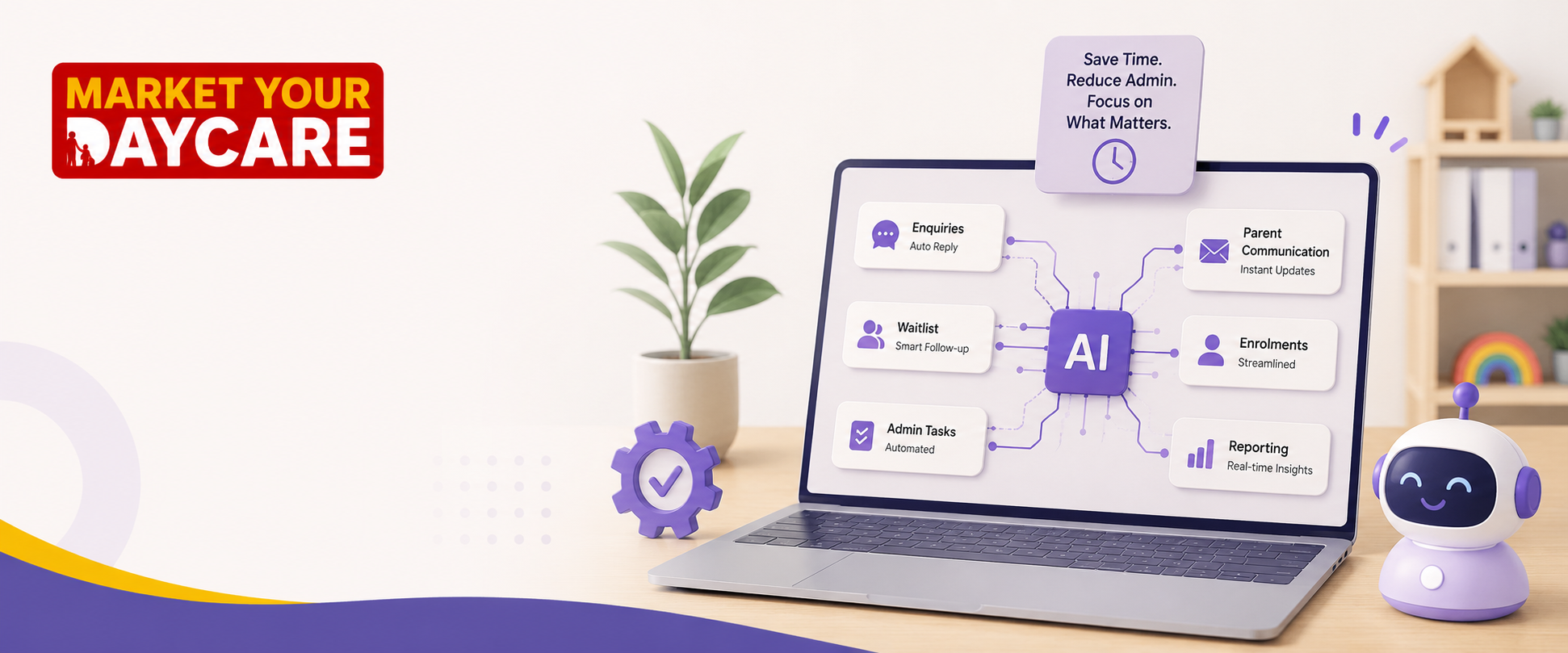
AI workflow automation just means you replace the "maybe" with "definitely." The enquiry comes in, the CRM logs it, an SMS goes out within 90 seconds, a follow-up task is assigned to a specific staff member with a 2-hour deadline, and if the call isn't made, the system sends a reminder. No human had to remember any of that. That's it. That's the "AI" most centres need in 2026.
The 3 Workflows Costing You Enrolments Right Now
There are about six stages in a childcare enrolment pipeline, and most centres are leaking at at least two of them. But three come up constantly when you look at underperforming AU centres.
The enquiry response gap. Data from across AU childcare centres shows that contacting a new enquiry within 2 hours of submission produces a 40-50% lead-to-tour booking rate. Waiting 24 hours? That drops to 18-25%. Same leads, same suburb, same fees. Just a different response time. This isn't an ads problem. It's a timing problem, and it's fixable with a basic automation.
The post-tour silence. A family comes in, sees your rooms, meets your educators, and walks out saying "we'll think about it." And then... nothing. No message at the 24-hour mark. No closing question. No answer to whether they can afford care once the Child Care Subsidy is applied. Three days later they've enrolled somewhere else — not because that centre was better, but because someone from that centre sent a two-sentence message and yours didn't.
The re-engagement black hole. You've got a spreadsheet somewhere (or maybe a CRM, maybe just a mental list) of families who enquired 3, 6, 9 months ago and never converted. Most centres never contact them again. An automated re-engagement sequence would have sent them something at the 30-day mark, and again at 60 days, and surfaced the timing mismatch — maybe they needed care in Term 3, not Term 1. That list is money.
AI Tools AU Centres Are Actually Using (Not Just Talking About)
Right, so what does this look like in practice? Not in theory. Not in a conference presentation. In a real AU childcare centre in 2026.
HubSpot or ActiveCampaign for lead nurture. Both have a free or low-cost tier that handles automated email sequences, lead tagging, and task creation when a form is submitted. A centre in Western Sydney I know of set up a 14-day nurture sequence in an afternoon. Not exaggerating — it was a Saturday, a staff member with no coding experience, and a YouTube tutorial. Now every new enquiry gets 5 touchpoints over 2 weeks without anyone lifting a finger.
Zapier or Make for connecting your tools. Your inquiry form, your CRM, your SMS platform, your Google Calendar for tour bookings — none of them talk to each other by default. Zapier connects them. When a form comes in, Zapier fires an SMS, creates a CRM contact, adds a task for the front desk, and logs it. Costs around $20-40 AUD a month depending on volume. Worth it on the first enquiry that doesn't fall through the cracks.
Google Reviews automation. The Google Maps Local Pack is where AU parents find childcare. The top 3 results in a suburb get the majority of clicks. Ranking in those 3 spots depends heavily on review volume and recency. An automated SMS sent to a family 48 hours after a positive interaction (tour, enrolment confirmation, first week of care) asking for a Google review will get you to 50+ reviews faster than anything else. One centre in Brisbane went from 11 reviews to 54 in 8 weeks doing exactly this. Didn't change anything else.
AI chatbot on the website (Tidio or Crisp). Not the kind that tries to replace your front desk. The kind that catches a parent browsing your site at 11pm — when your office is closed — and asks "Can I help you find information about enrolments?" and captures their details with a simple 2-field form. You call them in the morning. They're not a cold enquiry anymore, they're a warm one.
ChatGPT or Claude for content drafts. Your newsletter, your Facebook updates, your Google Business Profile posts. Not publishing AI content unedited — that's obvious and it reads poorly. But using it to draft something in 4 minutes that you then spend 3 minutes editing into your voice. Most centre directors I speak with spend 40-60 minutes a week on social content they hate producing. This cuts it to 15.
The Follow-Up Problem and Why AI Is the Fix
Here's the thing nobody says out loud: the reason follow-up doesn't happen isn't that your staff don't care. It's that following up on 20 leads across different stages of the pipeline while also managing staff ratios, NQF compliance, parent complaints, and the daily programme is genuinely impossible to do consistently from memory.
A person trying to remember to call a family at the 3-day mark, send an SMS at day 7, send an email at day 10, and re-engage at day 30 — without a system — will fail. Not because they're bad at their job. Because that's too many things to hold in your head when your primary job is running a childcare centre.
AI workflow automation doesn't replace the conversation. Kanav still has to be on the call. The centre director still has to run the tour. The educator still has to connect with the child. But the part where a task gets created, a reminder fires at exactly the right time, and a message goes out — that part doesn't have to live in anyone's head anymore.
What AI Can't Do (This Part Matters)
I want to be straight with you here because there's a lot of breathless content about AI that skips this section.
AI cannot run your tour. It cannot read the room when a parent is worried about their child's separation anxiety and pivot the conversation. It cannot build the trust that a warm, confident centre director builds in a 45-minute walk-through. It cannot produce the gut feel that makes a family say "yes, this is the place."
AI also cannot fix a fundamental positioning problem. If your centre doesn't appear in the top 3 on Google Maps, if your fee structure is confusing, if your website is landing on the homepage instead of a dedicated enrolment page — automating the follow-up on bad leads doesn't help. You still get bad leads, just faster.
The automation amplifies what's already there. If your centre genuinely delivers great care and the problem is the system around it, automation solves that. If the problem is somewhere else, you'll know quickly because the automations will work and the results still won't move.
How Market Your Daycare Ties This Together
Working with a specialist child care marketing agency is where a lot of this stops being theoretical and starts being installed. Market Your Daycare builds the full No Empty Seat Method for AU centres — which includes the paid traffic side (Google Ads, Meta Ads, Local Pack) but also the follow-up infrastructure, the tour conversion system, and the KPI tracking that tells you every week what's working.
The automation piece fits into Gear 3 and Gear 4 of the method. Gear 3 is lead nurture — the 2-hour rule, the 14-day sequence, the re-engagement of cold leads. Gear 4 is tour conversion — pre-tour confirmation, CCS gap fee communication during the tour, post-tour closing messages. Both are built on automation. Neither replaces the people doing the work. They just make sure the right thing happens at the right time, every time.
What a good child care marketing agency does that a generic digital agency doesn't is connect the automation to the sector reality. CCS income test timing, the NQF reassessment window, the Term 1/Term 3 occupancy dip — these aren't variables a generalist even knows exist, let alone builds automations around.
Conclusion
If you're running at under 85% occupancy and your follow-up system lives in someone's memory, the gap you're experiencing isn't a marketing gap. It's an infrastructure gap. And AI workflow automation in 2026 is genuinely good enough, cheap enough, and accessible enough to close it without hiring anyone new or spending a month setting it up.
Start with one thing. The 2-hour follow-up SMS. Build the trigger so that when an enquiry comes in, a text goes out within 90 seconds. That single change will move your lead-to-tour rate measurably within 30 days.
Then add the next thing. The post-tour message. The Google review request. The 30-day re-engagement.
None of it is hard. Most of it is just not set up yet. And that's the only difference between the centres sitting on waitlists and the ones still doing follow-up by memory.
FAQs
Q1. Do I need technical skills to set up AI workflow automation at my childcare centre?
Not really — and I'd say that even if I knew you were the least tech-savvy person in the room. Tools like Zapier, Tidio, and ActiveCampaign are built for non-developers. Most have pre-built templates specifically for lead follow-up. If you can set up a Gmail filter or create a Facebook post, you can get a basic follow-up automation running. The more complex setups (multi-site CRM logic, attributing leads back to specific ad campaigns) are where you'd want specialist help, but that's not where you need to start.
Q2. Will AI automation make my centre feel less personal to families?
Only if you do it badly. A personalised SMS that arrives within 90 seconds of an enquiry — using the parent's name and referencing the age group they asked about — actually feels more personal than an email that arrives the next morning from a shared inbox. The trick is writing the automated messages in your centre's actual voice. If your centre is warm and friendly, the automation should read that way. If it sounds corporate, that's a writing problem, not an automation problem.
Q3. What's the first automation a childcare centre should set up?
The 2-hour follow-up response. Not the 14-day sequence, not the review request system, not the chatbot. Just the trigger that fires an SMS and creates a task the moment an enquiry is submitted. Do that one thing first. It'll change your lead-to-tour rate before you touch anything else.
Q4. How much does this typically cost to run per month?
Cheaper than you think. A basic setup — Zapier (connecting your tools), an SMS platform like MessageBird or Twilio, and a free-tier CRM — runs around $80-150 AUD per month for a single centre. If you're already paying for a CRM or email platform, you may already have automation built in that you haven't turned on yet. A more complete setup with a proper lead nurture sequence and chatbot sits around $200-350 AUD per month. Compare that to a single empty seat at $2,800 a month and the maths becomes pretty easy.
Q5. Can AI automation help during seasonal occupancy dips like January and July?
Yes — and this is genuinely underused. The January dip (post-Christmas transitions, school-age children moving on) and the July dip (Term 3 transitions, age-group promotions) are both predictable. An automated seasonal re-engagement campaign — sent 6 weeks before the dip hits, targeting families who enquired but didn't enrol in the last 6 months — can fill seats before the vacancy even opens up. You know the dip is coming. Automation lets you do something about it 42 days before it arrives, not 3 days after it does.