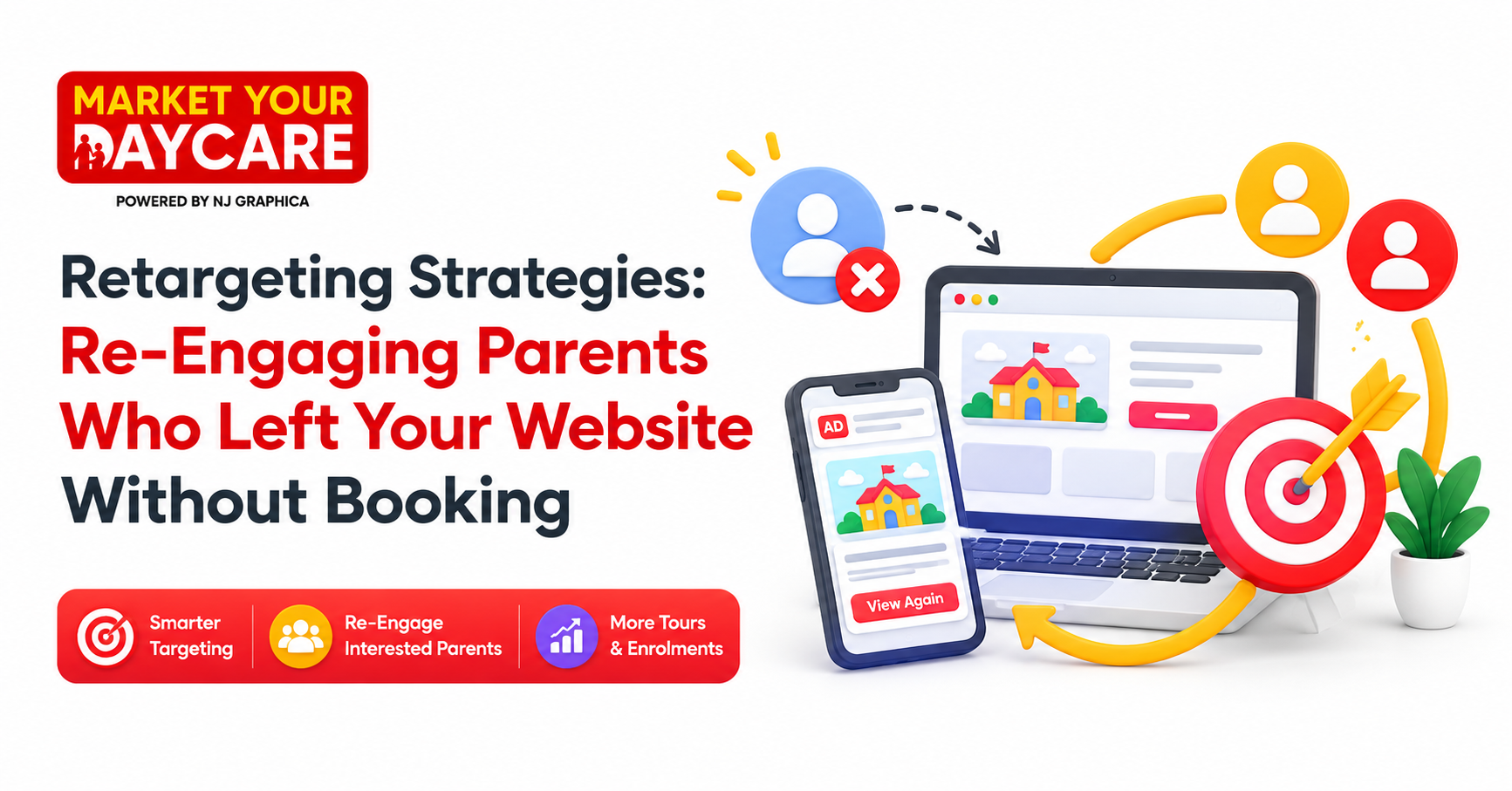

Retargeting lets you show tailored ads to parents who already visited your website but didn’t book a tour or send an enquiry. They’ve shown interest. They just need a nudge at the right time with the right message. When done well, this becomes a powerful part of your child care marketing mix. Instead of only chasing cold traffic, you’re re-engaging warm visitors who already know your centre exists. That usually means lower cost per enquiry, higher tour booking rates, and a smoother path from website visit to enrolment.
Table of Contents
-
What retargeting actually is
-
Why it matters for childcare centres
-
Who you should retarget (and who you shouldn’t)
-
What messages work best at each stage
-
Where to run retargeting ads
-
Budget, frequency, and avoiding creepiness
-
Measuring success without getting lost in data
-
Why Market Your Daycare matters
-
Conclusion
-
FAQ
What retargeting actually is
Retargeting (sometimes called remarketing) is a way to show ads to people who have already interacted with your business online. Most commonly, that means people who visited your website but didn’t complete a key action, like booking a tour or submitting an enquiry form.
Here’s the basic flow:
-
A parent visits your website.
-
A small piece of code (a pixel or tag) drops an anonymous cookie in their browser.
-
Later, when they’re on Facebook, Instagram, Google, or other sites, they see your ad.
-
The ad reminds them of your centre and invites them to take the next step.
You’re not targeting random people. You’re targeting people who already raised their hand by visiting your site. That makes them warmer, more qualified leads than a cold audience.
It’s not magic. It’s just follow-up, automated.
Why it matters for childcare centres
Childcare decisions aren’t impulse buys. Parents research. They compare. They sit on the fence.
A typical journey might look like:
-
Day 1: Google search, clicks your site, looks at programs and fees, leaves.
-
Day 3: Talks to partner, checks your Google reviews, visits a competitor’s site.
-
Day 7: Sees your retargeting ad on Instagram, remembers your centre, clicks through again.
-
Day 10: Books a tour after seeing a “limited spots” message.
-
Day 14: Attends tour, enrols.
Without retargeting, you might lose them after Day 1. With it, you stay visible during the decision window.
For centres, this matters because:
-
Website traffic is often wasted if you don’t follow up.
-
Parents who visit your site are already warmer than random locals.
-
Retargeting can lower your overall cost per enquiry by focusing budget on interested families.
-
It keeps your centre top-of-mind while they compare options.
In a competitive market, that edge can be the difference between a full room and a half-empty one.
Who you should retarget (and who you shouldn’t)
Not every visitor is worth retargeting. And you definitely don’t want to annoy people who already enrolled.
Good audiences to retarget
These are high-value groups:
-
General website visitors (last 30 days)
Parents who viewed your homepage, about page, or program pages but didn’t enquire.[ -
Program-page visitors
Parents who looked at specific age-group pages (e.g., toddlers, kinder). You can tailor ads to that stage. -
Tour-page visitors who didn’t submit
These are high-intent. They got close to booking but dropped off. They often just need a small push. -
Ad clickers who didn’t convert
People who clicked your Google or Meta ads, landed on your site, but didn’t complete an action. -
Video viewers and social engagers
Parents who watched your videos or engaged with your posts but haven’t visited your site yet. You can warm them further with website-focused retargeting.
Audiences to exclude
Equally important: who not to retarget.
-
Recent enquirers
If they’ve already filled out a form, you don’t need to keep showing them “Book a tour” ads. Move them into a nurture sequence instead. -
Current families
You don’t need to advertise enrolment to parents who are already enrolled. Exclude them to save budget and avoid confusion. -
Old, cold visitors
Someone who visited 180 days ago is probably no longer in-market. Focus on 30–60 day windows for most campaigns.
Smart retargeting is as much about exclusion as inclusion. You want to be helpful, not annoying.
What messages work best at each stage
One-size-fits-all ads don’t work well here. A parent who just landed on your homepage needs a different message than one who almost booked a tour.
Think in stages.
Stage 1: General visitors (awareness)
These parents know you exist but haven’t dug deep yet.
Ad angles:
-
“Discover [Centre Name] – Early learning in [Suburb]”
-
“See how we support belonging, being, and becoming”
-
Highlight your philosophy, environment, and educator team
Goal: build familiarity and trust, not hard-sell.
Stage 2: Program-page visitors (consideration)
They’ve shown interest in a specific age group or program.
Ad angles:
-
“Toddler program at [Centre Name] – Now enrolling for [Term/Year]”
-
“Kindergarten readiness with a play-based approach”
-
Feature benefits specific to that room: routines, learning outcomes, educator ratios
Goal: reinforce relevance and answer “Why this program?”
Stage 3: Tour-page drop-offs (decision)
These parents got close. They might have hesitated due to timing, fees, or uncertainty.
Ad angles:
-
“Book a tour this week – limited spots available”
-
“See our centre in action – tours running daily”
-
Add social proof: “Rated 5 stars by local families” or a short testimonial snippet
Goal: reduce friction and create gentle urgency.
Stage 4: Tour attendees who haven’t enrolled
If you can tag people who attended a tour (via CRM or form data), you can retarget them specifically.
Ad angles:
-
“Still thinking about [Centre Name]? Only X spots left for [age group].”
-
Share a parent testimonial video.
-
Address common objections: flexibility, CCS, transition support.
Goal: handle objections and tip them from “maybe” to “yes.”
The more tailored the message, the more it feels like a helpful reminder, not a random ad.
Where to run retargeting ads
You don’t need to be everywhere. You need to be where parents actually spend time.
Meta (Facebook and Instagram)
Meta is often the core of childcare retargeting.
Why it works:
-
Parents in your target age range (25–45) are highly active.
-
You can layer location, interests, and behaviours with website custom audiences.
-
Creative formats (images, carousels, short videos) suit storytelling.
Use cases:
-
Retarget website visitors with tour-focused ads.
-
Retarget video viewers and page engagers with website CTAs.
-
Run location-specific campaigns if you have multiple centres.
Google Display and YouTube
Google’s display network lets you show banner and video ads to past visitors as they browse other sites and watch YouTube.
Why it works:
-
Captures parents in a more research mindset.
-
Complements Meta by reaching people in different contexts.
-
Works well for brand reinforcement and reminder ads.
Use cases:
-
Show brand and philosophy ads to general visitors.
-
Use YouTube retargeting for parents who watched your centre video but didn’t enquire.
Search retargeting (RLSA)
Remarketing Lists for Search Ads (RLSA) let you bid differently for people who previously visited your site when they search again on Google.
Why it works:
-
These parents are re-entering the market actively.
-
You can bid higher for them because they’re warmer.
-
You can show more specific ad copy (“Welcome back – book a tour today”).
Use cases:
-
Target past visitors searching “childcare [suburb]” or “preschool near me.”
-
Adjust bids and ad text based on prior behaviour.
You don’t need all of these to start. Most centres do well with Meta retargeting first, then layer in Google as budget allows.
Budget, frequency, and avoiding creepiness
Retargeting can feel powerful. It can also feel creepy if you overdo it.
Budget allocation
A common split for childcare centres using both search and social is around 60% Google Ads (for active searchers) and 40% Meta Ads (for awareness and retargeting). Within that 40%, a good chunk can go to retargeting warm audiences.
For a small centre, you might start with:
-
$500–$1,500/month total on Meta, with 30–50% of that dedicated to retargeting.
-
Adjust up or down based on cost per enquiry and tour volume.
You don’t need huge spend. You need focused spend on the right people.
Frequency caps
Frequency cap = how many times a person sees your ad in a given period.
If parents see your ad 20 times a week, they’ll either tune it out or get annoyed.
A sensible starting point:
-
1–2 impressions per person per day on Meta retargeting campaigns.
-
Slightly higher on Google Display, but still monitored.
Most platforms let you set frequency caps at the ad set or campaign level. Use them.
Creative rotation
Even the best ad gets stale.
Plan to:
-
Refresh images every 4–6 weeks.
-
Test new headlines and CTAs regularly.
-
Rotate between philosophy, program-specific, and tour-focused creative.
That keeps your retargeting feeling fresh, not repetitive.
Avoiding the “stalker” vibe
A few simple rules:
-
Exclude recent enquirers and current families.
-
Don’t run aggressive “last chance” messaging too early in the journey.
-
Keep tone warm and helpful, not pushy.
-
Limit campaign duration (e.g., 30-day windows, then refresh).
When done right, parents think, “Oh yeah, I meant to book a tour there,” not “Why is this centre following me everywhere?”
Measuring success without getting lost in data
You don’t need a data science degree. You need a few clear metrics.
Core metrics to track
Focus on:
-
Retargeting impressions and reach
Are you actually reaching your warm audiences? -
Click-through rate (CTR)
Are your ads compelling enough to click? -
Cost per click (CPC)
How much does each click cost on average? -
Enquiries from retargeting
How many form fills, calls, or messages came from retargeting campaigns? -
Cost per enquiry (CPE)
Total retargeting spend divided by number of enquiries. -
Tours booked and enrolments (if trackable)
The ultimate measure: did retargeting help fill places?
Most platforms won’t show you full enrolment data unless you’ve set up advanced tracking. But even knowing enquiries and cost per enquiry is a huge step up from “hope it’s working.”
Simple reporting rhythm
Once a month, ask:
-
How many enquiries came from retargeting?
-
What was the approximate cost per enquiry?
-
Which audience segment performed best (general visitors, program-page, tour-page)?
-
Do we need to adjust budget, frequency, or messaging?
That’s enough to make smart tweaks without drowning in dashboards.
Common mistakes centres make
There are a few traps that keep showing up.
1. Retargeting everyone for too long
Running one big “website visitors last 180 days” audience with the same ad is inefficient. Segment by behaviour and keep windows tight (30–60 days).
2. No exclusion lists
Failing to exclude enquirers and current families wastes budget and annoys people. Always build exclusion audiences.
3. Generic creative
Using the same ad for all stages dilutes impact. Tailor messages to where parents are in the journey.
4. Expecting instant miracles
Retargeting improves conversion over time. It won’t fix a broken website or unclear offer, but it will lift performance when the basics are solid.
5. Not connecting to the broader funnel
Retargeting works best when paired with:
-
A clear “Book a Tour” path on your site
-
Follow-up emails or SMS for enquirers
-
A smooth tour-to-enrolment process
Otherwise, you’re just sending traffic into a leaky bucket.
Avoiding these mistakes keeps your retargeting efficient and parent-friendly.
The link between retargeting and occupancy
Here’s the bigger picture.
Every parent who visits your site and doesn’t enquire is a potential enrolment lost. Retargeting helps you recover a portion of that lost demand.
When done well, it:
-
Increases total enquiries without necessarily increasing total traffic
-
Lowers overall cost per enquiry by focusing on warmer audiences
-
Shortens the decision timeline for hesitant families
-
Supports steady tour bookings, which stabilises occupancy
In a sector where each vacant place costs thousands per month, even a handful of extra enrolments per quarter is significant.
Retargeting isn’t a silver bullet. But it’s one of the highest-leverage tools in a modern childcare marketing mix.
Why clear communication matters
Let’s circle back to the human side.
Retargeting isn’t about tricking parents into booking. It’s about making sure the families who are already interested don’t forget you while they’re comparing options.
Your ads should feel like a helpful nudge, not a hard sell. Warm tone, clear value, and respectful frequency go a long way.
When your messaging aligns with what parents actually care about—safety, learning, flexibility, community—retargeting becomes an extension of good service, not just an ad tactic.
And that’s the kind of marketing that builds trust, not just clicks.
Why Market Your Daycare matters
This is where marketyourdaycare fits in.
Market Your Daycare focuses on helping Australian childcare centres reach 90–100% occupancy through results-driven marketing. That includes using retargeting not as a gimmick, but as a structured part of the enrolment funnel.
A specialised agency understands that child care marketing isn’t about blasting ads to everyone. It’s about reaching the right local families, at the right time, with the right message.
Working with a team that gets this context means:
-
Retargeting audiences segmented by behaviour (general, program-specific, tour-page)
-
Creative tailored to each stage of the parent journey
-
Exclusion lists to avoid wasting budget on enquirers and current families
-
Integration with your broader Google and Meta campaigns
-
Reporting focused on enquiries, tours, and occupancy impact, not just impressions
That’s the difference between running random ads and running a system designed to fill your rooms.
Turning warm traffic into enrolled families
At the end of the day, retargeting is about respect for your own traffic.
You’ve already paid (in time, SEO effort, or ad spend) to get parents to your site. Retargeting helps you make the most of that investment by staying visible while parents decide.
When you combine thoughtful segmentation, tailored messaging, and sensible frequency, you create a gentle, effective follow-up system. One that feels helpful to parents and profitable for your centre.
And in a world where attention is scattered and competition is high, that consistency can be a real advantage.
Conclusion
Retargeting isn’t about chasing parents. It’s about staying present for families who already showed interest but haven’t taken the next step.
When you use it thoughtfully—segmented audiences, stage-appropriate messages, and clear metrics—it becomes a powerful part of your child care marketing. It helps you convert more of the traffic you already have, lower your cost per enquiry, and keep your tour pipeline steady.
Done right, it’s not creepy. It’s just good follow-up.
FAQ
1. What is retargeting for childcare centres?
Retargeting shows ads to parents who already visited your website but didn’t book a tour or enquire, keeping your centre visible while they compare options.
2. Which audiences should I retarget?
Focus on recent website visitors, program-page viewers, and tour-page drop-offs. Exclude recent enquirers and current families to save budget and avoid annoyance.
3. What messages work best in retargeting ads?
Use stage-based messaging: brand and philosophy for general visitors, program benefits for page-specific visitors, and tour invitations with social proof for high-intent drop-offs.
4. Where should I run retargeting campaigns?
Meta (Facebook and Instagram) is often the core, with Google Display, YouTube, and search retargeting as complementary channels depending on budget and goals.
5. How do I know if my retargeting is working?
Track enquiries, cost per enquiry, tour bookings, and (if possible) enrolments from retargeting campaigns, and adjust audiences, creative, and budget based on those results.