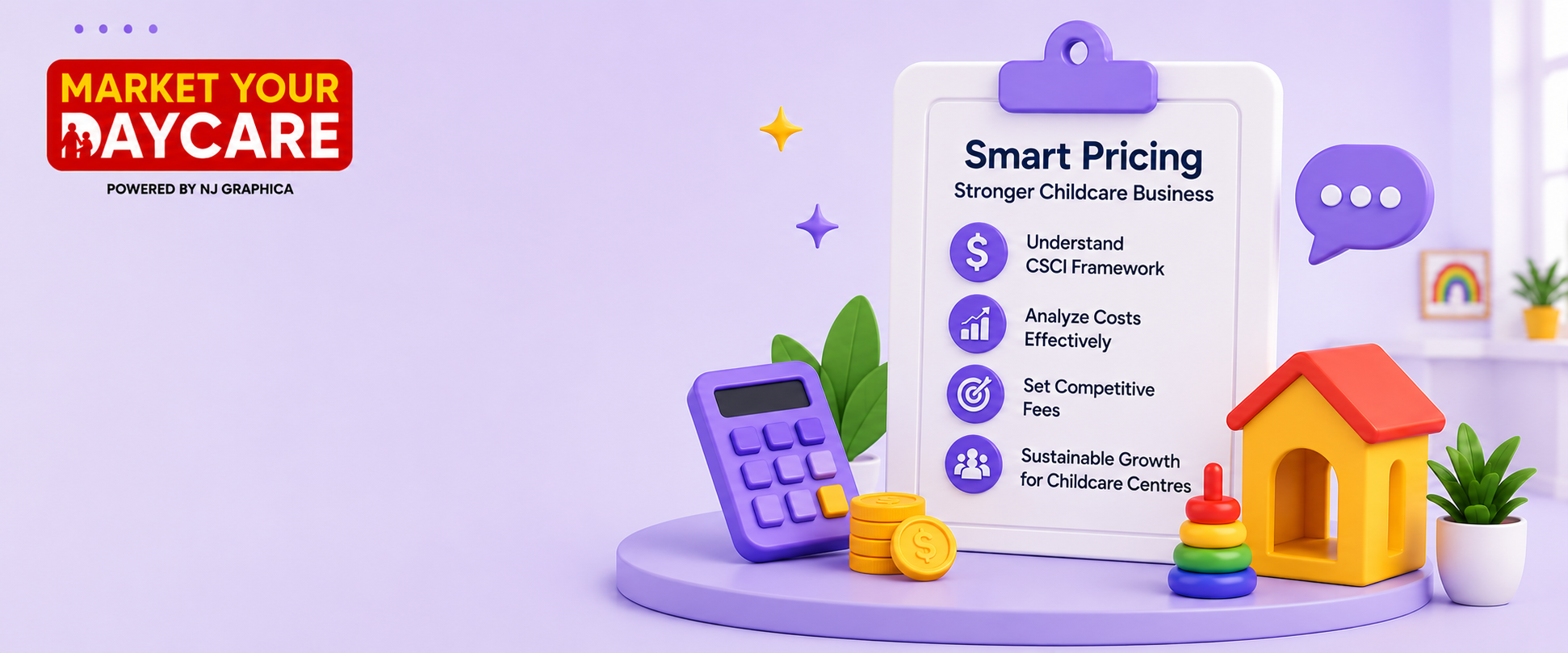
The ABS Childcare Services Cost Index (CSCI) measures how the costs of running a childcare service change over time. It tracks things like wages, consumables, utilities, and other inputs that providers pay for. That’s different from the childcare CPI, which looks at what families pay. As a leading childcare marketing agency in australia, we closely follow these economic shifts to help providers navigate rising operational expenses while maintaining predictable enrolment growth.
For centre owners and directors, the CSCI matters because it gives you a clearer picture of your cost pressures. It helps you decide when and how much to adjust fees, how to plan your budget, and how to explain changes to families without sounding defensive. When you pair that with smart communication, a childcare marketing agency in Australia can help you turn a tricky pricing conversation into a trust-building one.
Table of Contents
-
What the CSCI actually is
-
How it’s different from the childcare CPI
-
Why CSCI matters for your pricing strategy
-
Using CSCI to plan fee reviews
-
Communicating fee changes to families
-
Why Market Your Daycare matters
-
Conclusion
-
FAQ
What the CSCI actually is
The CSCI is published by the Australian Bureau of Statistics (ABS). It measures the change in prices that childcare providers pay for the goods, services, and labour they need to run their centres.abs.gov+1
Think of it like this: if you’re buying more expensive cleaning products, paying higher energy bills, or increasing educator wages to stay competitive, the CSCI is designed to reflect those cost movements from the provider’s perspective.
It started being published from the December quarter of 2024 as part of the Producer Price Indexes. Since then, it’s been released each quarter, showing both quarterly and annual percentage changes.abs.gov+1
The ABS developed this index to give the sector better data on cost pressures. Before this, providers often had to rely on general inflation measures or internal spreadsheets. Now there’s a dedicated index just for childcare services.
And yes, it’s technical. But you don’t need to be a statistician to use it. You just need to understand what it’s telling you about your own costs.
How it’s different from the childcare CPI
This is where people get tripped up.
The childcare CPI (Consumer Price Index) measures changes in the fees that families pay for childcare, after accounting for subsidies like the Child Care Subsidy (CCS). It’s focused on the household side.abs.gov+1
The CSCI, on the other hand, is focused on the provider side. It looks at what it costs you to deliver the service.abs.gov+1
So:
-
Childcare CPI = what families are paying
-
CSCI = what you’re paying to run the centre
Both matter. But they answer different questions.
If the childcare CPI is rising faster than the CSCI, it might mean families are feeling more pressure than providers are. If the CSCI is rising faster, it might mean your costs are outpacing what families are being charged, which can squeeze your margins.
That’s why looking at both gives you a fuller picture.
Why CSCI matters for your pricing strategy
Here’s the part that affects your day-to-day.
Your pricing strategy isn’t just about “what can we charge?” It’s about “what do we need to charge to stay sustainable while remaining attractive to families?”
The CSCI gives you a benchmark.
Let’s say your internal data shows your costs have gone up 7% over the last year. The latest CSCI shows a 6.5% annual increase. That tells you your experience is broadly in line with the sector. If your costs are up 10% while the CSCI is at 6.5%, that’s a signal to dig deeper. Are you facing local wage pressures? Higher rent? Specific operational issues?
On the flip side, if your costs are only up 4% but the CSCI is at 6.5%, you might have some room to invest in quality, staff development, or marketing without immediately needing to raise fees.
That kind of insight helps you move from reactive pricing (“everyone else is increasing, so we will too”) to strategic pricing (“here’s what our costs are doing, here’s what the sector is doing, and here’s how we’ll respond”).
And that’s a much stronger position to be in when you’re talking to your board, your team, or your families.
Using CSCI to plan fee reviews
Most centres do an annual fee review. Some do it twice a year. Either way, the CSCI can be a useful input.
Here’s a simple way to think about it:
-
Check the latest CSCI annual percentage change.
-
Compare it to your own cost growth over the same period.
-
Look at local market conditions and occupancy.
-
Decide on a fee adjustment that balances sustainability and affordability.
You’re not going to copy the CSCI number exactly. It’s a guide, not a rule. But it helps you avoid guessing.
For example, if the CSCI shows a 6% annual increase and your costs are similar, a fee increase in that ballpark is defensible. If you’re planning to go significantly higher, you’ll want a clear reason, like major upgrades, new programs, or local market data showing higher fees are common.
It also helps with timing. If you know the CSCI is published quarterly, you can align your internal reviews with those releases so you’re always working with fresh data.
And if you’re part of any government programs that reference the CSCI, like the Early Childhood Education and Care Worker Retention Payment program, it becomes even more relevant. Some fee growth limits are tied to CSCI movements, so staying on top of it isn’t just good practice. It can be a compliance issue.abs.gov+1
Communicating fee changes to families
This is where a lot of centres struggle.
You can have the most logical, data-driven fee review in the world. But if families don’t understand why fees are changing, they’ll feel frustrated. Maybe even angry.
The CSCI can help you frame the conversation.
Instead of saying, “We’re increasing fees because costs are up,” you can say something like:
“Like many services, we’re seeing ongoing increases in wages, utilities, and everyday supplies. National data from the ABS shows childcare operating costs have risen by X% over the past year. To continue delivering the quality of care and education your children deserve, we need to adjust our fees in line with these pressures.”
That’s not defensible. It’s transparent.
You’re not hiding behind vague phrases. You’re pointing to real data. And you’re connecting it back to what families care about: quality, stability, and continuity of care.
You don’t need to overload parents with charts and percentages. Just a clear, honest explanation goes a long way.
And this is where working with a childcare marketing agency in Australia can make a real difference. They can help you craft messages that are calm, clear, and parent-friendly. They can also help you plan the timing, channels, and follow-up so the conversation doesn’t feel like a one-off email drop.
Practical example of a fee review process
Let’s walk through a realistic scenario.
You’re the director of a 100-place centre. It’s mid-year, and you’re starting to think about next year’s fees.
Step one: you pull your internal cost data. Wages, rent, utilities, insurance, consumables, maintenance. You work out your total cost growth over the last 12 months. Let’s say it’s 7.2%.
Step two: you check the latest CSCI. The annual change is 6.8%. That tells you your cost growth is slightly above the sector average, but not wildly out of line.
Step three: you look at your occupancy. You’re at 92%, with a small waiting list. Local centres are charging similar or slightly higher fees.
Step four: you decide on a fee increase of 6.5% for the coming year. It’s close to the CSCI, slightly below your own cost growth, but still sustainable given your occupancy and local market.
Step five: you prepare your communication. You write a letter to families explaining the change, referencing cost pressures and the CSCI in simple terms. You give at least 8–12 weeks’ notice. You offer a Q&A session for parents who want to talk it through.
That’s a clean, professional process. It’s not perfect for every family, but it’s fair, transparent, and grounded in data.
Common mistakes centres make with pricing
There are a few patterns that keep showing up.
1. Only using CPI
Many centres just apply a generic CPI increase every year. That can work, but it doesn’t reflect your specific cost structure. The CSCI is more tailored to childcare providers, so it’s a better fit.abs.gov+1
2. Waiting until the last minute
Fee changes announced with short notice feel abrupt. Families need time to adjust their budgets. Planning ahead shows respect.
3. Not explaining the why
A simple “fees are increasing” email creates anxiety. A short explanation that links to cost pressures and quality reassures families that this isn’t arbitrary.
4. Ignoring local market data
National indexes are useful, but your local area might be different. Some regions have higher wage pressures, higher rents, or different competitive dynamics. Combine CSCI with local intelligence.
5. Treating pricing as purely financial
Pricing is also a marketing and trust issue. How you communicate it matters as much as the number itself.
Avoiding these mistakes doesn’t guarantee happy reactions from every family. But it does reduce confusion and build credibility.
The link between pricing and occupancy
Here’s something that often gets overlooked.
Your pricing strategy doesn’t just affect revenue. It affects occupancy. And occupancy affects everything: staffing ratios, team morale, cash flow, and long-term sustainability.
If your fees are too low relative to your costs, you might fill places quickly, but you’ll be running on thin margins. One unexpected expense can throw you off.
If your fees are too high relative to the value families perceive, you might struggle to attract and retain enrolments, even if your quality is excellent.
The CSCI helps you find a middle ground. It gives you a data-backed way to set fees that cover your costs while staying realistic for families.
And when your pricing feels fair and well-explained, families are more likely to stay. That stability is gold in a sector where turnover and vacancies can be costly.
Why clear communication matters
Let’s zoom in on the communication piece again, because it’s that important.
Imagine two centres. Both need to increase fees by around 6–7% due to rising costs.
Centre A sends a short email: “Fees will increase from next term. New fee schedule attached.”
Centre B sends a longer message: explains cost pressures, references national data like the CSCI, connects it to quality and continuity, and offers a time for parents to ask questions.
Which centre do you think keeps more trust?
Centre B isn’t necessarily cheaper. But it feels more respectful. More transparent. More like a partner.
That’s the kind of difference that keeps families enrolled even when fees go up.
And that’s where a good agency can help. Not by hiding the increase, but by framing it in a way that makes sense to parents.
Why Market Your Daycare matters
This is where marketyourdaycare.com fits into the picture.
As a leading childcare marketing agency in australia, Market Your Daycare focuses on helping Australian childcare centres reach 90–100% occupancy through results-driven marketing. That includes supporting centres with messaging around fees, value, and quality.
Pricing isn’t just a finance conversation. It’s a brand conversation. How you position your fees, how you explain changes, and how you connect price to value all shape how families see your centre.
A specialised agency can help you:
-
Craft clear, calm fee-change communications.
-
Align your pricing story with your overall brand.
-
Use data like the CSCI to back up your message.
-
Plan the timing and channels for maximum clarity.
-
Support occupancy goals while protecting trust.
That’s different from a generic marketing provider. A childcare-focused agency understands the nuances of CCS, fee caps, local competition, and parent psychology.
So when you’re thinking about how the CSCI impacts your pricing strategy, it’s not just about the number. It’s about how you use that number to tell a credible story to families.
Turning data into confidence
At the end of the day, the CSCI is a tool. It’s not a magic fix. But it does give you something many centres don’t have: a shared, national benchmark for cost movements in childcare.
When you use it well, it helps you:
-
Plan fee reviews with more confidence.
-
Explain changes without sounding defensive.
-
Align your pricing with your actual cost structure.
-
Keep your centre financially sustainable.
And when your pricing feels fair and well-communicated, families are more likely to stay. That’s how you protect both your revenue and your reputation.
Conclusion
The ABS Childcare Services Cost Index isn’t just a statistic. It’s a practical guide for how you think about fees, costs, and sustainability. When you understand what it’s telling you, you can move from reactive pricing to strategic pricing.
Pair that with clear, honest communication, and you’ve got a strong foundation for keeping families on board even when fees need to change. And when you work with a childcare marketing agency in Australia that understands the sector, you can turn a potentially tense conversation into a trust-building one.
FAQ
1. What is the ABS Childcare Services Cost Index (CSCI)?
The CSCI is an index published by the Australian Bureau of Statistics that measures changes in the costs childcare providers pay for goods, services, and labour.abs.gov+1
2. How is CSCI different from the childcare CPI?
The childcare CPI measures changes in fees paid by families, while the CSCI measures changes in costs paid by providers.abs.gov+1
3. How often is the CSCI published?
The CSCI is published each quarter as part of the ABS Producer Price Indexes, showing quarterly and annual percentage changes.abs.gov+1
4. Can I use the CSCI to set my fees?
You can use it as a guide alongside your own cost data and local market conditions. It’s not a rule, but a benchmark to inform your pricing strategy.
5. Why work with a childcare marketing agency in Australia for pricing communication?
A specialised agency can help you explain fee changes clearly, connect pricing to value, and maintain trust with families while supporting your occupancy goals.